Technical reading
Business reading
Live public product. 84/84 is the automated test suite, not OCR accuracy.
HeatScan AI
Public pipeline: OpenCV prepares the nameplate image, PaddleOCR extracts the text, values are normalised, and RapidFuzz ranks them against 534 cleaned records in PostgreSQL. Docker and Nginx serve the public app. Across July 15 – August 12, 2026 the documented effort was 402 hours, and the automated suite reached 84/84. That figure is the test suite, not OCR accuracy. Internal EVH infrastructure is not described.
A live product that identifies heating equipment from a nameplate photo, so retrofit and advisory work can start from a product match instead of a manual reading. It is public at heatscan.abhiinayy.in. The documented build, July 15 – August 12, 2026, is 402 hours, 534 cleaned records and a fully passing test suite. The test count is not an accuracy claim.
- documented development hours
- 402
- cleaned product records
- 534
- automated tests passing
- 84/84
- development period
- 4 weeks
Stack, architecture and test detail sit in the Technical reading. This view stays with the problem, who it helps, and what is live or still planned.
1. The problem
Heating systems are installed, replaced and maintained over decades. Identifying the exact manufacturer, model and efficiency class often means manually reading a nameplate, interpreting inconsistent labels and searching through product documentation.
That process is slow, error-prone and difficult to scale. It also creates friction for energy-technology teams who need reliable asset information to plan retrofits, assess efficiency and support customers.
Who it helps
Energy-technology teams need to know which heating equipment is already installed. Reading a nameplate by hand is slow, and the labels are inconsistent.
HeatScan AI is the public product for that job: a photo in, a likely product match out, with a catalogue the person can still search and check.
2. Why it matters
The energy transition depends on knowing what is already installed. Accurate heating-system identification supports retrofit planning, efficiency classification, district-heating decisions and customer advisory work.
A practical identification tool reduces manual effort while making the underlying product data easier to use and verify.
3. Product overview
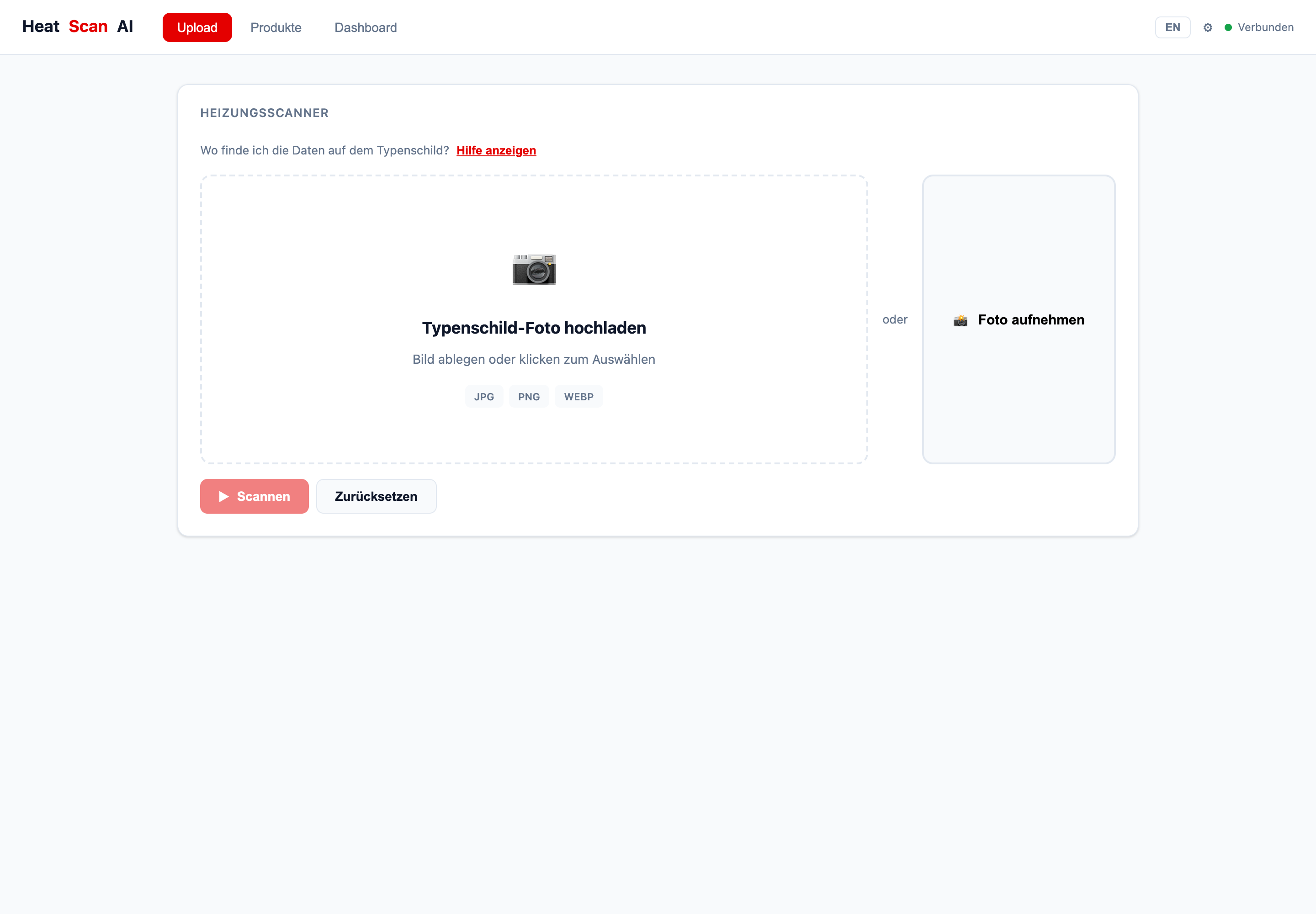
HeatScan AI lets a user photograph a heating nameplate or upload several images. The platform extracts text, identifies likely manufacturer and model information, and matches the result against a cleaned product catalogue.
- Multi-image upload and in-browser camera capture
- OCR-based extraction from heating nameplates
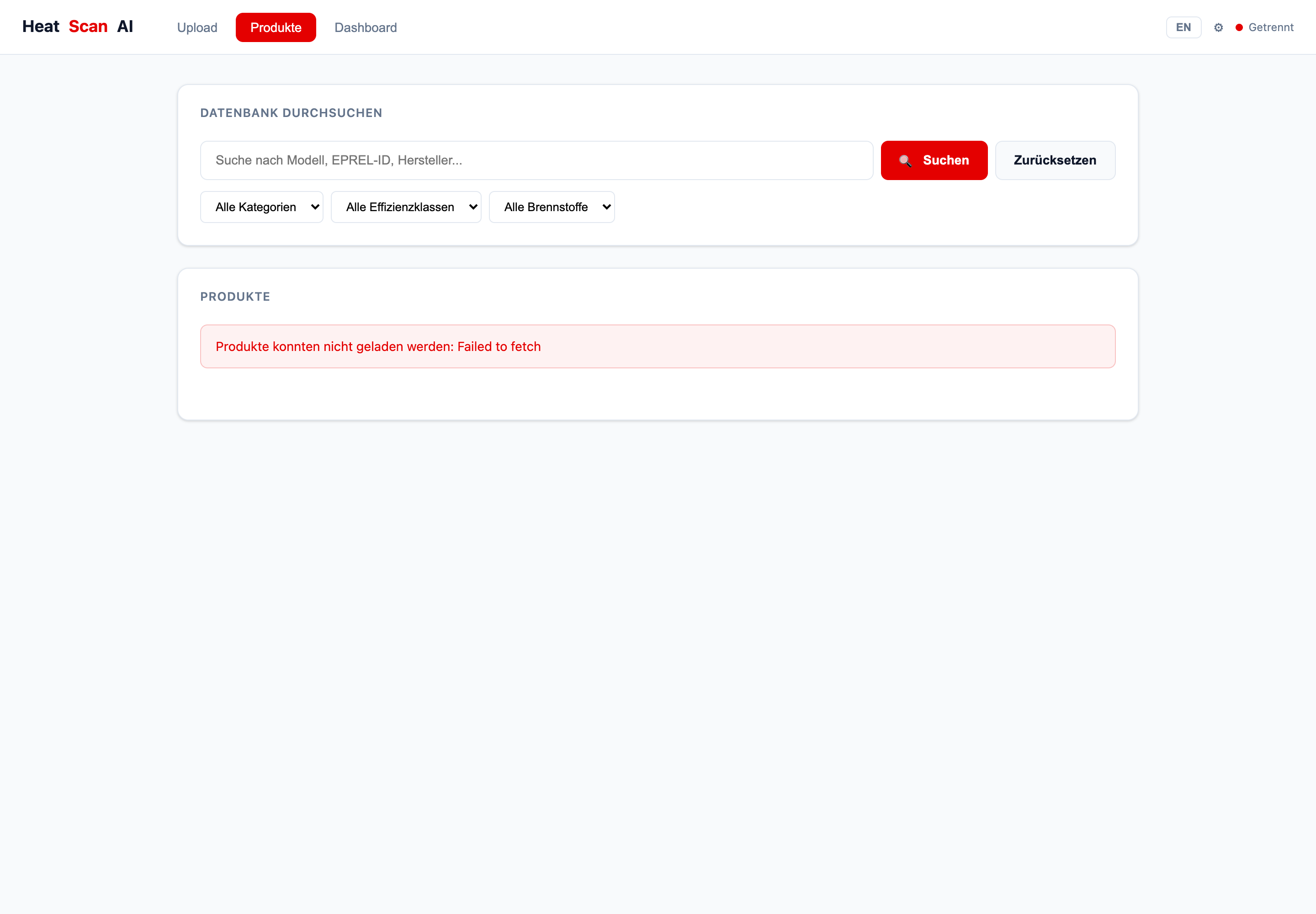
- Product database search and filtering
- Intelligent matching against cleaned product records
- German and English interface
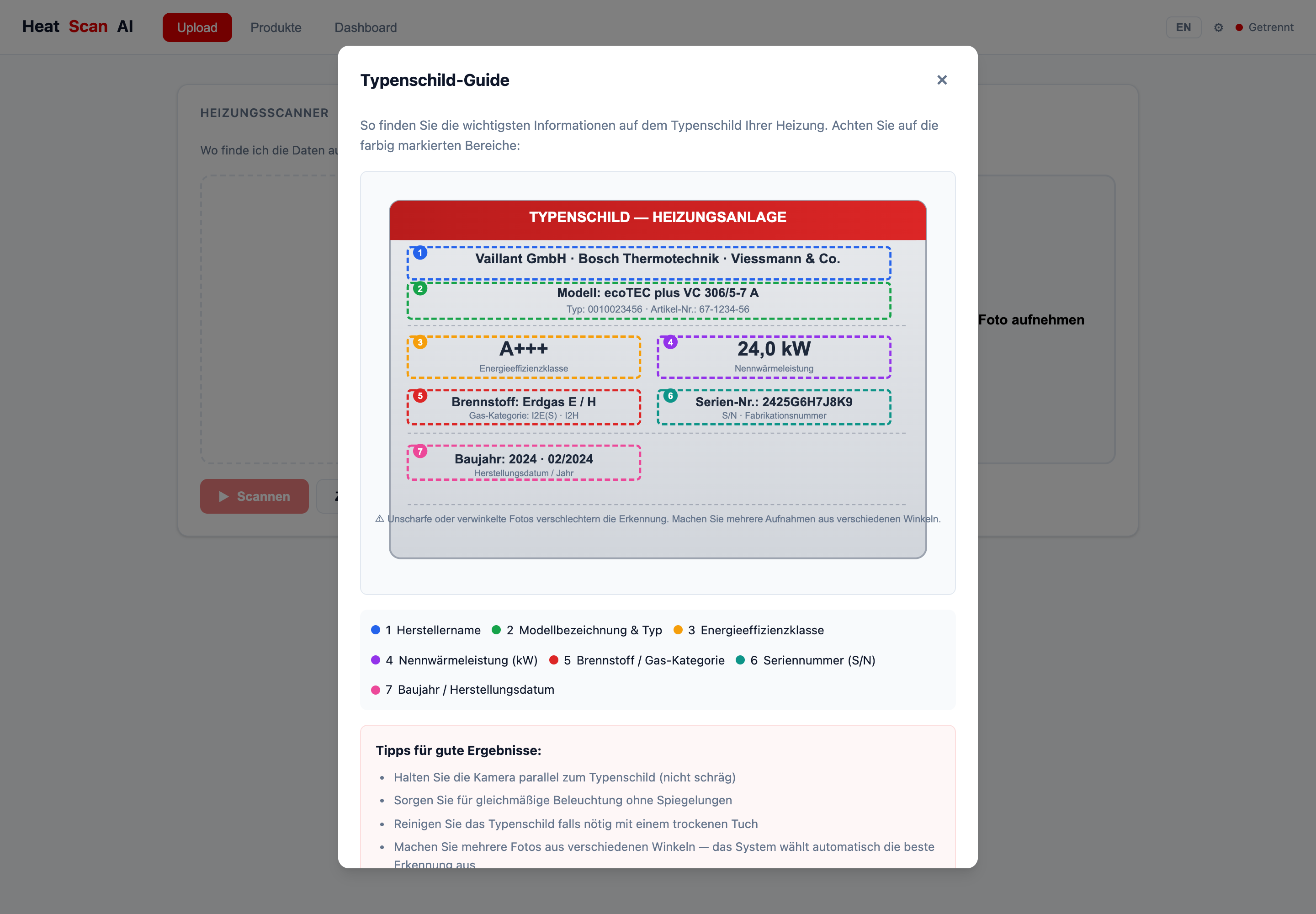
- Public nameplate guide for better capture quality
- Privacy notice and consent flow
What is live
The scanning interface, the nameplate guide and the product search are public at heatscan.abhiinayy.in, in German and English.
The documented build ran from July 15 to August 12, 2026: 402 development hours, 534 cleaned product records, and 84 of 84 automated tests passing. The test figure is the suite. It is not an OCR accuracy score.
4. My contribution
I contributed as a Working Student in AI / Software Development at EVH — Energieversorgung Halle. My work covered the applied AI and software engineering needed to turn a practical identification problem into a working product.
- Built OCR and image-processing workflows for nameplate data extraction
- Prepared and cleaned product records for matching
- Worked on intelligent product matching and candidate ranking
- Integrated product database and public product-data workflows
- Implemented and maintained automated tests
- Contributed to containerized deployment and production readiness
5. Technology stack
The stack was chosen for practical computer vision, reliable data handling and straightforward deployment.
- PaddleOCR for text recognition
- OpenCV for image preprocessing
- Python for the application and identification logic
- PostgreSQL for product and scan data
- EPREL public database integration for product information
- RapidFuzz for fuzzy product matching
- Docker for containerized deployment
- Nginx as the public reverse proxy
6. High-level system architecture
At a public level, HeatScan AI is a web application with a clear separation between the user interface, image-processing pipeline, matching logic and product data store.
- 01
Client
Browser-based upload, camera capture, results and product search.
- 02
Web layer
Nginx serves the public application and routes requests to the application service.
- 03
Processing
OpenCV prepares images; PaddleOCR extracts text from nameplates.
- 04
Matching
Extracted fields are normalized and compared with product records using RapidFuzz.
- 05
Data
PostgreSQL stores product catalogue data and application records; public EPREL data informs product details.
7. OCR and identification workflow
- 01
Capture
The user uploads one or more nameplate photos or takes a photo with the device camera.
- 02
Preprocess
Images are normalized to improve readability before text recognition.
- 03
Extract
PaddleOCR extracts text from each image, including manufacturer, model and efficiency information.
- 04
Normalize
Extracted values are cleaned and standardized to reduce noise and formatting variance.
- 05
Match
RapidFuzz compares candidate values against cleaned product records and ranks likely matches.
- 06
Confirm
The user reviews the result and can continue with product search or a new scan.
8. Engineering challenges
The engineering work was as much about data quality and failure handling as it was about the OCR model itself. A useful result depends on preprocessing, normalization, sane candidate ranking and a clear confirmation step.
- Nameplates vary widely in layout, typeface, language and print quality.
- Glare, angle, blur and partial captures reduce OCR quality.
- Manufacturer and model names appear in many abbreviations and formats.
- German characters and technical units require careful normalization.
- Multiple images of the same nameplate need to be reconciled into a useful result.
- Fuzzy matching must balance recall against false positives.
- The product catalogue needs consistent records before matching can be reliable.
9. Testing and validation
The project reached 84/84 automated tests passing. Testing covered the public application behaviour and the identification workflow, including image handling, OCR fixtures, normalization logic, matching edge cases and result handling.
A cleaned catalogue of 534 product records formed the data foundation for matching and validation.
- 84 of 84 automated tests passing
- 534 cleaned product records
- Test coverage across the identification workflow
- Manual review of public product-search behaviour
10. Deployment overview
HeatScan AI is deployed as a containerized web application behind Nginx, with environment-based configuration and a public HTTPS endpoint.
- Docker-based application packaging
- Nginx reverse proxy
- HTTPS public access
- Environment-based configuration
- Public privacy and consent flow
11. Results and learnings
HeatScan AI shipped as a working public product with a practical workflow for heating-system identification. The project produced 402 documented development hours, 534 cleaned product records and a fully passing suite of 84 automated tests across a four-week development period from July 15 to August 12, 2026.
The biggest lesson was that applied AI products succeed or fail on the quality of the surrounding system: preprocessing, data normalization, matching strategy, explainable candidate ranking and a user who can confirm the result.
- 402 documented development hours
- 534 cleaned product records
- 84/84 automated tests passing
- July 15 – August 12, 2026
- Public deployment at heatscan.abhiinayy.in
Public product views
Screenshots from publicly accessible product pages. No internal systems or customer data are shown.